

What a 2095 Vision Can Tell Us About Our Work Now
In 2023, a group of fellows convened by N Square* was asked to engage in a thought experiment: what becomes possible if nuclear weapons are removed from the human story? Fifty years after an imagined disarmament date of 2045, how might the world be organized in their absence? The result, An Operating System for the 22nd Century, is a catalog of eight interlocking systems—new forms of security, citizenship, energy cooperation, legal accountability, and more.
Reading it today, the resonance with Horizon 2045’s current work is hard to miss.
The report opens with a diagnosis that sounds familiar: climate change can spark a pandemic; a pandemic can trigger economic fragility; economic fragility can fuel armed conflict; armed conflict can degrade the ecosystems that prevent the next pandemic. The fellows describe this as a dilemma for global security. Each risk must be addressed on its own terms, but no single approach is sufficient to address the multifaceted nature of these entangled threats. This is a foundational idea behind Horizon 2045; these risks compound in ways that exceed the capacity of institutions traditionally meant to handle them independently. The architecture governing these risks must be redesigned as an interconnected system.
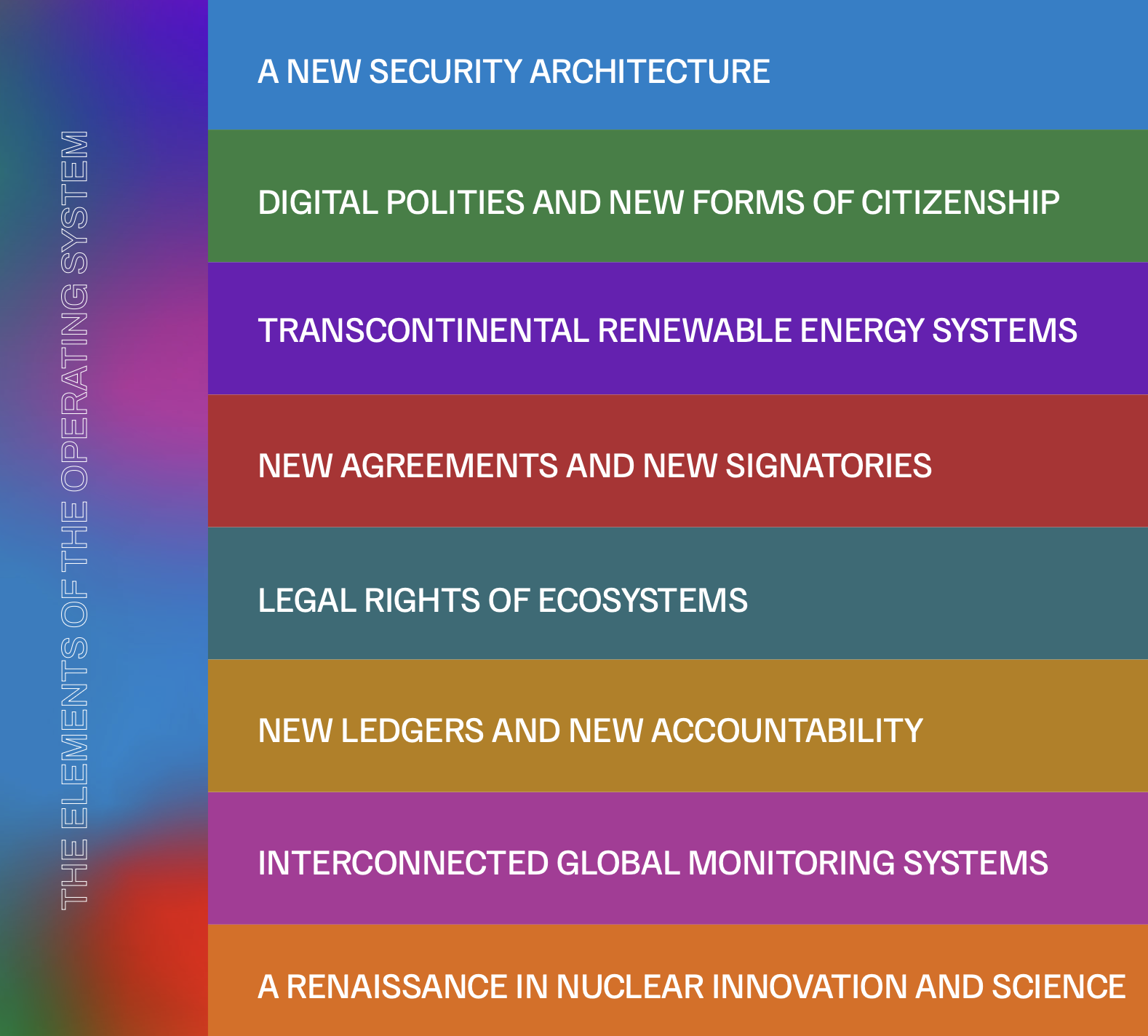
The eight elements of the Operating System report are not a blueprint. They function more like protocols for governing, enabling interoperability between governance and participatory structures above and below the scale of the nation-state, rather than demanding agreement on a single vision. Several of them illuminate why reimagining security is so necessary, and what becomes possible when an integrated approach succeeds.
The Legal Rights of Ecosystems
The OS report imagines a legal settlement in 2075 granting rights to Lake Erie. Corporate executives would be required to walk the shores annually, confront the effects of their companies’ practices, and measure their progress against a binding agreement.
In fact, Horizon 2045 is laying the groundwork for such a scenario right now. Since 2024, through our Lex Mundi Nova program, Horizon 2045 has consulted with nearly 100 interdisciplinary experts to build the legal case that the entire nuclear weapons lifecycle–from uranium mining and testing to production, deployment, and waste—constitutes an ongoing assault on the rights of future generations and the wellbeing of all living systems. Drawing on advances in environmental law, human rights law, and the emerging legal rights of future generations, this work aims to delegitimize nuclear weapons not as a single moment of use, but as a continuous harm embedded in every stage of their existence.
Both approaches share a core insight: the legal tools needed already exist in adjacent domains. Now, the task is translation. And nuclear law is only the starting point: the same integrated lens can extend to how we govern and adjudicate security challenges more broadly.
New Agreements and New Signatories
The OS report envisions a time in 2065 when around 1.25 billion people become individual signatories to a binding international agreement on climate and peace. In this world, non-state advocates build new platforms so indigenous nations, underrepresented communities, and young people can pressure governments directly rather than waiting to be represented by them.
Horizon 2045’s Women Transforming Global Security program, a partnership between The Elders, Horizon 2045, and Ploughshares, is building exactly this kind of leadership infrastructure today: more than 50 high-profile international women leaders actively engaged in redefining global security, supported by governance tools that make visible how decisions in one domain compound the risk or create opportunity in another. The Nuclear Futures Fellowship extends the same logic to a younger cohort. Through the fellowship, emerging leaders are trained to anticipate nuclear risk reduction and disarmament strategies in a landscape that has changed drastically since the Cold War.
New Ledgers and New Accountability
Also conceptualized in the report is a new distributed ledger system—the Human Rights DAO—which becomes a universal non-legal framework for protecting human rights by tracking over a million transactions per day and driving accountability through consumer adoption rather than state enforcement. Today, Horizon 2045’s Anticipatory Philanthropy work approaches the accountability problem from a different angle, but with a similar underlying logic: supporting philanthropic leaders with the tools, training, and shared intelligence to deploy capital where it generates the greatest leverage across the interconnected challenges.
Interconnected Global Monitoring Systems
The OS report further describes a world where citizen sensor data, satellite imagery, and cross-border scientific collaboration have merged into a single system capable of catching threats early, including tracking nuclear weapon development, greenhouse gas emissions, and disease outbreaks at a global scale. Horizon 2045’s international horizon-scanning networks and the Foresight Radar are an early, real-world version of this insight—preemptive searches for evidence of coming futures across interconnected threat domains rather than monitoring risks as separate streams of information.
Where Horizon 2045 Picks Up
The OS report is explicit about its own limits; it doesn’t predict a particular future. And there’s one question it deliberately declines to answer: what replaces nuclear deterrence as a mechanism for holding geopolitical threats in place, once the weapons themselves are gone?
This is precisely the territory Lex Mundi Nova and the Nuclear Futures Fellowship inhabit. They do not exactly imagine a world without nuclear weapons, but are doing the legal and institutional work to get there without creating a security vacuum in the process.
The Operating System report suggests three uses for itself: as a cue for reflection and discussion, as a point of reference for ongoing investigation, and as a prompt for action. These map onto Horizon 2045’s own methods: studying change through horizon scanning, envisioning change through collaborative foresight, and spearheading change through convening diverse groups of leaders.
That third use, prompt for action, is the one that matters most. The fellows who wrote the Operating System report were not futurists by trade. They were people who spent a few months acting on behalf of future generations, imagining a future none of them will be around to witness.
Horizon 2045 is working on a shorter horizon. But the discipline is the same: describe the world you want to build in enough detail that someone can start building it now, before the crisis that would force the issue anyway. The nuclear weapons lifecycle, the leadership networks, the philanthropic tools, the scanning systems: none of these wait for permission from a treaty or a summit. They are the early architecture of a world organized differently, envisioned and designed while the old one is still standing.
*Horizon 2045 emerged as the organization it is today from a project N Square launched in 2020 with the Nuclear Threat Initiative and the Rhode Island School of Design’s Center for Complexity. You can read more about this here.
Author: Ava Lee-Green, Horizon 2045 Intern
