
GOVERNANCE FLAGSHIP
Lex Mundi Nova
PHILANTHROPY FLAGSHIP
Lex Mundi Nova, the law of the new world, leverages new developments in international law to achieve a world in which using, and even threatening to use, nuclear weapons is universally and unambiguously illegal.
Bolstering International Law and Governance
Lex Mundi Nova advances legal and diplomatic strategies to strengthen international law and governance constraining nuclear weapons by leveraging wider developments in climate law, human rights, public health, and intergenerational equity, creating a template for governance of entangled threats.
It innovates by forging legal connections across existential risk spaces. It’s currently spearheading multi-stakeholder research, consultations, and events to advance new legal pathways to reduce new nuclear risks such as AI in NC3 systems, and to close a loophole the International Court of Justice (ICJ) left open in its 1996 Advisory Opinion on the Legality of the Threat or Use of Nuclear Weapons. A ruling that to this day incentivizes proliferation, and contributes to a growing global power asymmetry because it is exploited by nuclear weapons states to justify their growing arsenals.
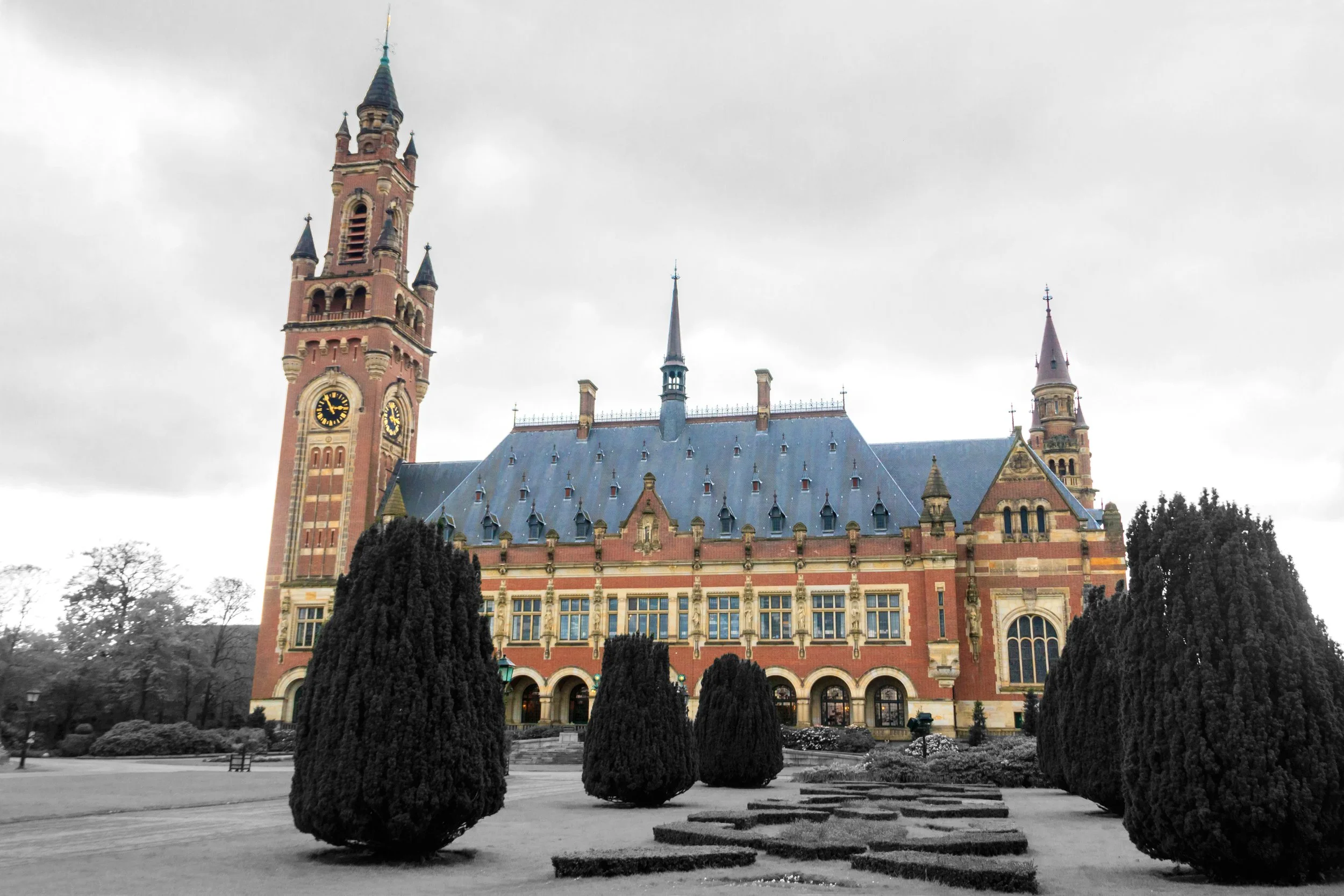
The UN International Court of Justice (above) is housed in the The Peace Palace in the Hague.
Why Now
Arguably, nuclear risk has never been higher. While there have been a number of new international agreements constraining nuclear weapons since the 1996 ICJ Nuclear Weapons Advisory Opinion, there have been numerous, significant developments in ‘nuclear adjacent’ areas, particularly in international law protecting the environment and the human rights of present and future generations, as seen notably in the ICJ 2025 Climate Change Advisory Opinion.
These legal developments are underexplored and underutilized. They can be used to further delegitimize and stigmatize nuclear weapons and to constrain nuclear states’ behavior by increasing the political cost of possession, testing, threat, and use. In this era beset by multiple, converging crises, now is the time to use them.
Why Us
At our founding, in collaboration with the Nuclear Threat Initiative, we developed the Nuclear Weapons System Map which helped us identify new ways to to influence power and strengthen governance. We also developed a map of legal frameworks connected to nuclear weapons, and an intergenerational justice timeline. Developing these tools enabled us to step back and look beyond the typical legal framing for nuclear weapons threats and harms. This, to understand not just advances in bedrock legal principles, but where and how emerging law and norms can—both now and in the future—disrupt the nuclear weapons status quo.
Since 2024, we’ve formally consulted with 80+ interdisciplinary experts from 50+ institutions worldwide. This has enabled us to identify new and emerging legal and normative developments to address emergent risks, support existing legal frameworks, bolster international governance, and reverse the current backsliding on nuclear disarmament.
Having identified the most consequential unresolved questions of law and evidence on nuclear harms, we are now identifying the arguments that answer them—through our first-in-kind webinar series and in the commissioning of new studies. This, in preparation for an expert convening on pathways for adjudicating the legality of nuclear weapons. We are also expanding our coalition of state, civil society, and academic partners to ensure that non-state actors, and non-nuclear weapons states, have an equal say in the global governance of this serious, existential risk.
Lex Mundi Nova is led by two lawyers operating at the intersection of international law, diplomacy, policy, and complex systems.

2026 WEBINAR SERIES
The ICJ Advisory Opinion on the Legality of the Threat or Use of Nuclear Weapons 30 Years On: What Legacy and What Now?
With partners and expert panelists from around the world, the Lex Mundi Nova webinar series explored the legacy of the landmark 1996 Advisory Opinion of the International Court of Justice (ICJ) on the Legality of the Threat or Use of Nuclear Weapons. By examining the ruling itself, the shifts in international law and new science in the last three decades, and emerging technological and geopolitical risks—from nuclear testing, to AI, to warfare in space—the series considered whether the ruling’s ambiguities and gaps can and should be resolved in light of today’s legal and evidentiary realities.
HOSTED BY
Danielle McLaughlin is a litigator, legal strategist, and author working to mobilize law, legal institutions, and global governance to reduce nuclear weapons risks.
Kathleen Lawand brings over 30 years of international legal and policy experience including 24 years with the International Committee of the Red Cross (ICRC) where she led multidisciplinary teams in complex multi-stakeholder initiatives, including the negotiations of the Treaty on the Prohibition of Nuclear Weapons.
The ICJ Advisory Opinion on the Legality of the Threat or Use of Nuclear Weapons 30 Years On: What Legacy and What Now?
HOSTED BY
Danielle McLaughlin is a litigator, legal strategist, and author working to mobilize law, legal institutions, and global governance to reduce nuclear weapons risks.
Kathleen Lawand brings over 30 years of international legal and policy experience including 24 years with the International Committee of the Red Cross (ICRC) where she led multidisciplinary teams in complex multi-stakeholder initiatives, including the negotiations of the Treaty on the Prohibition of Nuclear Weapons.
With partners and expert panelists from around the world, the Lex Mundi Nova webinar series explored the legacy of the landmark 1996 Advisory Opinion of the International Court of Justice (ICJ) on the Legality of the Threat or Use of Nuclear Weapons. By examining the ruling itself, the shifts in international law and new science in the last three decades, and emerging technological and geopolitical risks—from nuclear testing, to AI, to warfare in space—the series considered whether the ruling’s ambiguities and gaps can and should be resolved in light of today’s legal and evidentiary realities.
With Your Help, We Will
Sustain Legal Analysis: Continue integrated legal analysis spanning the law of armed conflict, state responsibility, human and environmental rights, and intergenerational justice.
Grow the Coalition: Expand an engaged and viable coalition of states, civil society, academics, and policymakers in development of legal and diplomatic strategies.
Host High-Impact Sessions: Convene high-impact working sessions and summits to advance evidentiary, legal, and political grounds to strengthen international law and institutions.
Produce Legal Materials: Generate legal briefs, memos, and public-facing materials to be used in legal processes and to shape nuclear weapons policy.
Anchor Secretariat Infrastructure: Provide operational and secretariat infrastructure sustaining continuity and rigor across multi-year campaigns in international and regional legal institutions.