

Why We Created Watershed
A watershed is a ridge. On one side, water flows one way; on the other, it flows in a different direction. Everything in the basin drains toward a common point. That is why the word came to mean a turning point, a moment that determines which way everything afterward runs.
We named our new zine Watershed because we believe we are living inside one. The governance frameworks that have shaped international security since 1945 are under pressure from every direction, and what we build to replace or repair them in this decade will shape what comes next for a long time. That is why we at Horizon 2045 think it matters to prototype and test new governance models now.
Water is a good place to start.
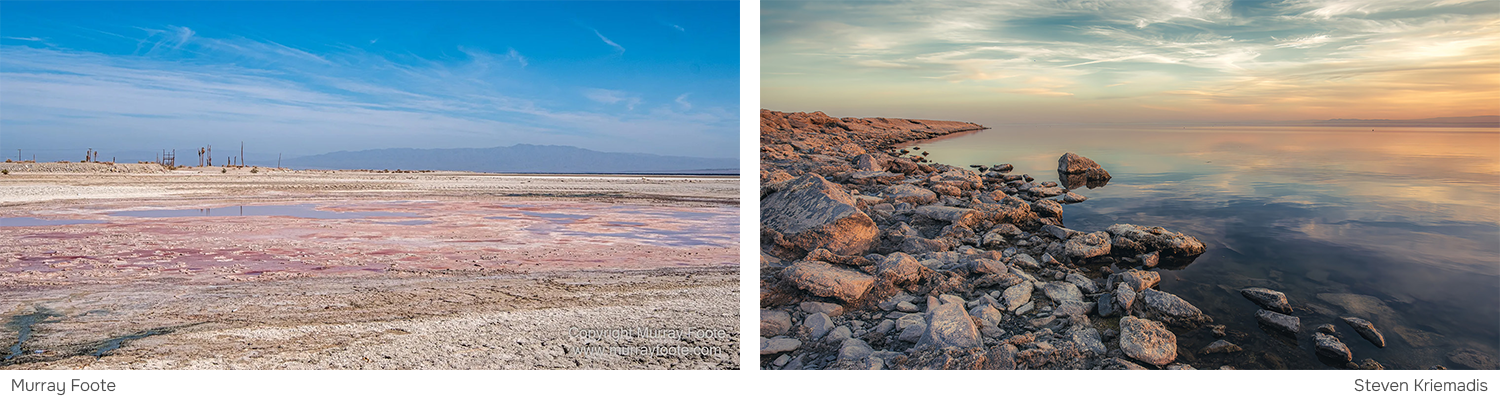
The Salton Sea is California’s largest inland body of water, and for decades it was a symbol of what happens when a shared resource is nobody’s explicit responsibility. As water inflows dropped, the sea shrank, wildlife habitat collapsed, and the exposed lakebed began releasing dust that blanketed the Imperial Valley with some of the worst air quality in the state, falling hardest on farmworker communities that had no hand in causing it. Solving it required everyone, including farmers, tribal nations, environmental groups, and community advocates like Alianza Coachella Valley working alongside state and federal agencies through the Salton Sea Management Program. In May 2025, water began flowing into the first restored habitat ponds. It is not finished. But it is working because the people who needed it to work decided to build it together.
The Salton Sea Management Program is not an anomaly. It is part of a pattern.
When scientific proof emerged that industrial chemicals were destroying the ozone layer, 197 countries agreed to phase them out. The chemicals were profitable, the industries were powerful, and the cooperation happened anyway. The Montreal Protocol has been described as the single most successful international agreement ever reached, and the ozone hole over Antarctica is measurably smaller today than it was at its peak.
When the Cold War ended and Russia inherited large stockpiles of highly enriched uranium, enough for about 20,000 nuclear warheads and at risk of falling into the hands of black marketeers, the United States and Russia struck a deal to convert the weapons-grade material into commercial reactor fuel and sell it to American utilities. Over the following two decades, it supplied roughly ten percent of all electricity consumed in the United States. One analyst called it the only time in history when disarmament was actually profitable. Twenty thousand potential warheads were converted at no cost to taxpayers into electricity for American homes. The model said that should not be possible between adversaries. It happened anyway.
Humans cooperate.
These are not isolated cases. They follow a pattern that shows up across history and across cultures. When people share a clear understanding of what is at stake, when the process is inclusive, and when leadership is willing to act on evidence, cooperation works. Political scientist Robert Axelrod showed that in repeated interactions, where the same actors encounter each other over time, cooperation is the winning strategy. Nobel Laureate Elinor Ostrom spent decades documenting communities that managed shared resources without collapsing into competition.
Anthropologist David Graeber and archaeologist David Wengrow’s survey of the archaeological record found that collective governance and mutual aid are not utopian ideas but recurring features of human history. The CAF World Giving Index finds that the most generous giving, measured as a share of income, comes not from wealthy nations or institutions but from individuals in lower-income countries giving directly to people in their own communities. Generosity is not a function of abundance. It is a function of connection.
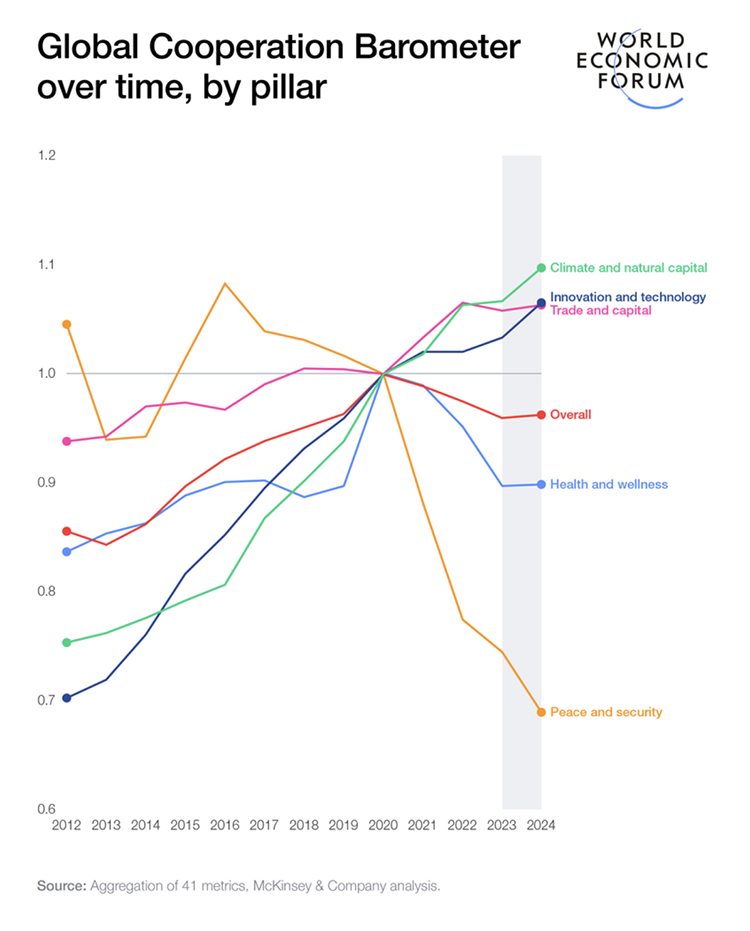
The story that competition and coercion are human defaults is not a fact. It is a choice about what to believe, built into institutions that now treat it as a given. And pessimism, whatever anyone tells us, is not realism. It too is an epistemic choice. The World Economic Forum’s Global Cooperation Barometer captures where things stand. Formal multilateral institutions are under pressure, and peace and security cooperation has declined. But cooperation in technology, services, and regional initiatives continues to grow, what analysts call “patchwork resilience.” Cooperation has not failed. The frameworks designed to channel it at the scale this moment requires have simply not kept pace.
This gap has a history. In 1945, the world built new institutions from the rubble of a war that had killed sixty million people. The UN Charter, the Bretton Woods system, and the Geneva Conventions were genuine achievements, and they shaped everything that followed. But the Cold War that arrived almost immediately captured the dominant meaning of security before it could fully settle. By the 1950s, the word had been narrowed to something specific and consequential. It came to mean the preservation of states, the management of arsenals, and peace maintained through the threat of annihilation. Security, in the frame that came to dominate international institutions, meant mutual fear. It meant mutually assured destruction.
That frame has been contested ever since, and the debate tracks a recognizable arc. In the 1970s, détente and arms control introduced the idea of managed competition. States could negotiate limits even while remaining adversaries. In 1982, Olof Palme’s Common Security commission made a more fundamental argument. Security is indivisible. You cannot build it on your neighbor’s insecurity. In 1994, the UN Human Development Report proposed a people-centered definition organized around freedom from fear and want across seven dimensions of everyday life, including economic, food, health, environmental, personal, community, and political security. In 2000, UN Security Council Resolution 1325 recognized that inclusive processes produce more durable peace. The years since have added environmental security, planetary boundaries, One Health, climate security, and intergenerational security. Each one is a successive argument that the original Cold War definition was too narrow, too state-centric, and too organized around competition to address the actual conditions of human and planetary life.
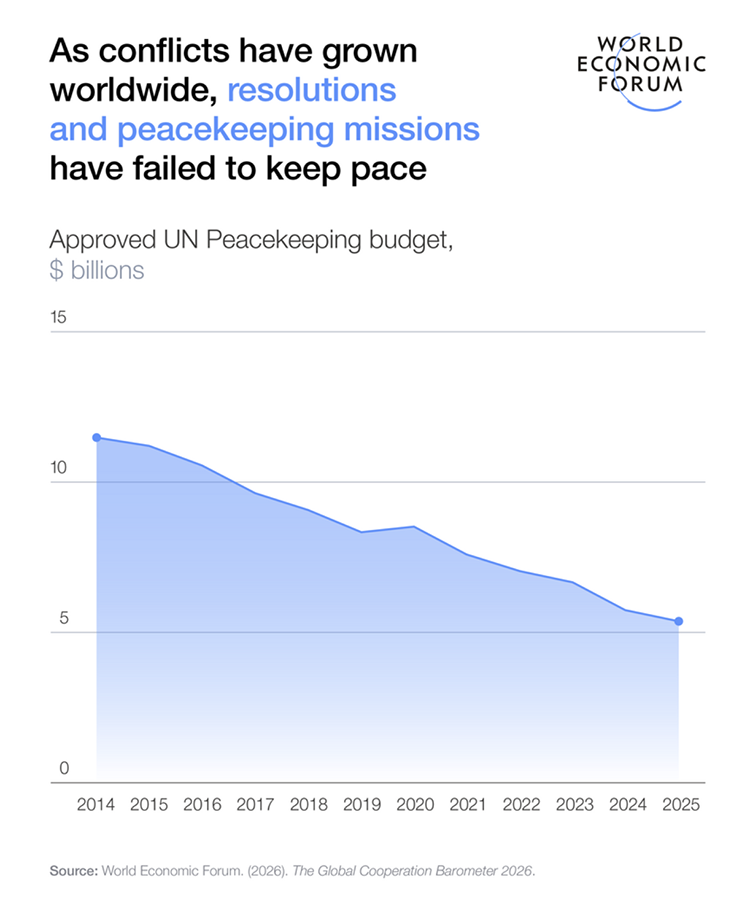
The pattern across eight decades is clear: The definition of security has been moving, steadily and with increasing urgency, away from the preservation of states and toward the wellbeing of people and planet, but security governance has not adequately evolved.
The institutions built in 1945 remain the primary frame. The mental models that captured security during the Cold War remain embedded in how those institutions operate, what they fund, and whose expertise they recognize. Social scientist S.M. Amadae has argued that the Prisoner’s Dilemma was not a discovery about human nature. It was a model built for a specific political moment, one that assumed rational actors would defect rather than cooperate, helped rationalize mutually assured destruction, and became embedded in the institutions now responsible for the most consequential decisions on earth. In parallel, the countries of the Global South have called for a more just, equitable, representative, and sustainable international order. Together, these arguments point in the same direction. We need new definitions of security that move beyond state-centric thinking to prioritize long-term human survival and planetary stability.
This is the moment to act on that argument. Moments of fragmentation and institutional failure are also, historically, the moments when the rules get rewritten. The institutions of 1945 were built by people who understood they were writing rules that would shape everything that followed. They were right. The frameworks being built and tested in this decade will do the same. The difference is that this time, the entanglement of threats means the rules cannot be written domain by domain, state by state, threat by threat. They have to be written for a world where security means human and planetary wellbeing, where cooperation is the operating logic rather than the exception, and where the ingenuity required to find the points of intersection between challenges is treated as the strategic asset it actually is.
Those questions do not have settled answers. They are alive, contested, and consequential. And they deserve a place where serious people can work on them in public, across the boundaries that usually keep them apart.
That is why we created Watershed.
Why a Zine
Watershed exists because we wanted a place to think out loud about all of this and to find the people who are thinking about it too.
Not a newsletter. Not a communications vehicle. A publication in the original sense, a place where ideas are worked out in public, where the intellectual commitments behind the work are made explicit, and where the people doing the work can encounter each other across the boundaries that usually keep them apart. The security scholar who keeps running up against the limits of the mental models her field takes for granted. The legal theorist who sees in climate litigation a precedent that nobody in nuclear policy has yet applied. The funder who suspects that her colleagues already hold knowledge that would make her own decisions more effective, and that the same is true in reverse, if only there were a way to see across the silos.
Watershed is where those conversations happen. Each issue takes up a question that runs beneath the standard security agenda and asks what it looks like when you take it seriously.
The inaugural issue, produced in collaboration with Ploughshares, is on foresight and the nuclear field. The connection between them runs deeper than most people realize.
Nuclear weapons were the first technology to make planetary-scale catastrophe possible within an afternoon. They were also, less visibly, the catalyst for strategic foresight as a discipline. The scenario planning and futures methods now used across business, government, and civil society were largely invented to think about nuclear war. And then the nuclear field walked away from them, narrowing its analytical lens toward quantifiable risk models at precisely the moment the questions at stake most required imagination. This issue is an argument for taking them back up.
Future issues will ask what security means in an era of entanglement, what genuine innovation in democratic practice requires, what it means to govern with responsibility to future generations, and what the roles of imagination and foresight are in the redesign of governance itself.
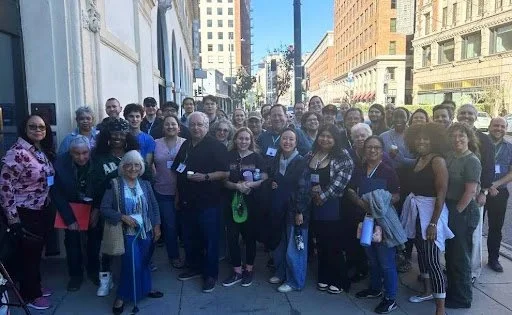
Democracy Assembly in LA (Photo – democracy.community)
The answers to those questions are not settled. That is precisely why they belong in a publication rather than a policy brief. The work of changing mental models at the scale this moment requires does not happen through better analysis of existing frameworks. It happens when enough people who have sensed that something is wrong at the root find each other and begin to build the alternatives.
That is what Watershed is for. Visit the inaugural issue, Nuclear Futures, at watershed.pub.
Author: Erika Gregory, Horizon 2045 President