
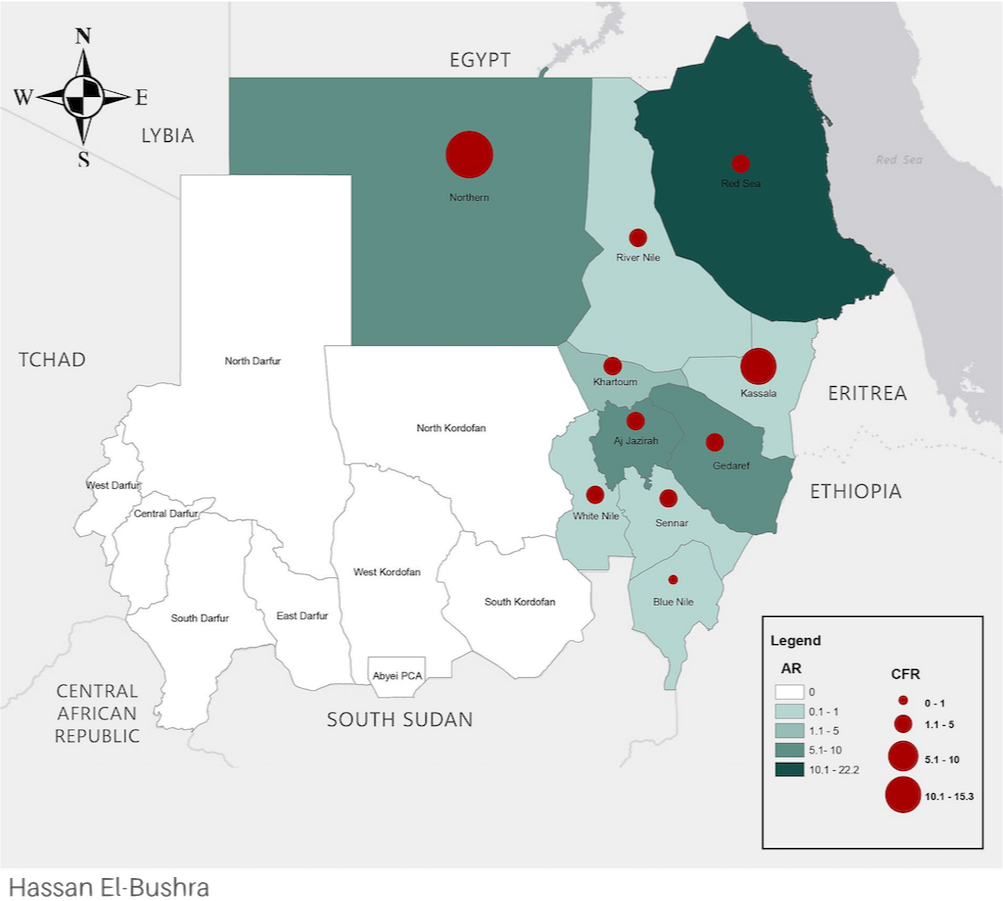
Map showing cholera distribution during the conflict in Sudan. From the International Journal of Infectious Diseases.
In August 2024, sixteen months into a war between the Sudanese Armed Forces and the paramilitary Rapid Support Forces, health authorities confirmed a cholera outbreak. The disease did not spread in a stable country: water and sanitation services had broken down, and millions had fled their homes to live in crowded camps.
Contaminated water and desperate thirst created the conditions for cholera to thrive in Sudan. Over the next nineteen months, the outbreak spread throughout the country and infected more than 124,000 people. It killed 3,573 of them. Then, in March 2026, the government declared it over.
Oral vaccination campaigns run by Sudan’s Federal Ministry of Health, the World Health Organization, and UNICEF reached millions of people. Even so, the declaration answered only the narrowest question: whether one pathogen was still spreading. However, during those same months, fighting had also halted routine immunizations, so malaria, dengue, measles, polio, hepatitis E, and diphtheria were also being reported from several states.
More than a third of health facilities were not running. Over four million people were acutely malnourished, meaning their bodies had few resources to fight the next infection. Cholera was just the first visible evidence of a larger system failure which continued to unfold after the declaration.
Cholera itself came back two months after the declaration, starting in West Kordofan state, on the dividing line between army and paramilitary zones of control. By September 2026, WHO had reported about 2,900 cases and 247 deaths across six states.
A health ministry would file the outbreak and its return under disease, a defense ministry under conflict, and a finance ministry under neither. The Horizon 2045 Foresight Radar, which tracks signals of change across seven domains of human and planetary security, treats the outbreak as one multidimensional problem and examines it through three lenses: authority, materials, and money.
Begin with authority. The Radar records a global decline in the rule of law. In Sudan, WHO has verified 217 attacks on health care since April 2023. The count does not say who carried them out, but it shows that the rules protecting hospitals in war are not holding. Those rules have always depended on someone willing and able to enforce them, and in a country divided between army and paramilitary control, it is unclear who could provide that enforcement.
For response to be timely and effective, reliable supply chains must be in place before an outbreak, which the Radar lists among its signals of vulnerability. In Sudan, the UN reports that bureaucratic delays, looted aid convoys, and active fighting have hindered deliveries of vaccines, therapeutic food, and medical kits.
Response also depends, of course, on money. As of November 2026, only 50.8 percent of Sudan’s 2026 Humanitarian Needs and Response Plan has been funded. The Radar also lists rising global debt and military budgets, both of which could compete with outbreak response for public funds.
Not every signal points toward deterioration or crisis. The Radar also records growing cooperation around water, and cholera is fundamentally a problem of access to water. In a country where water services have broken down, this signal marks a place where positive interventions can take hold.
The signals in this account come from several of the Radar’s domains, including Governance & Politics, Finance & Economics, and Infrastructure. Traditionally, each domain has its own experts and its own ways of addressing a problem. The Foresight Radar helps analysts understand a single entanglement through multiple lenses. It cannot predict a crisis like the cholera outbreak in Sudan, but it suggests that when multiple signals appear at once, there is reason to act early.
Author: Ava Lee-Green, Horizon 2045 Intern
