
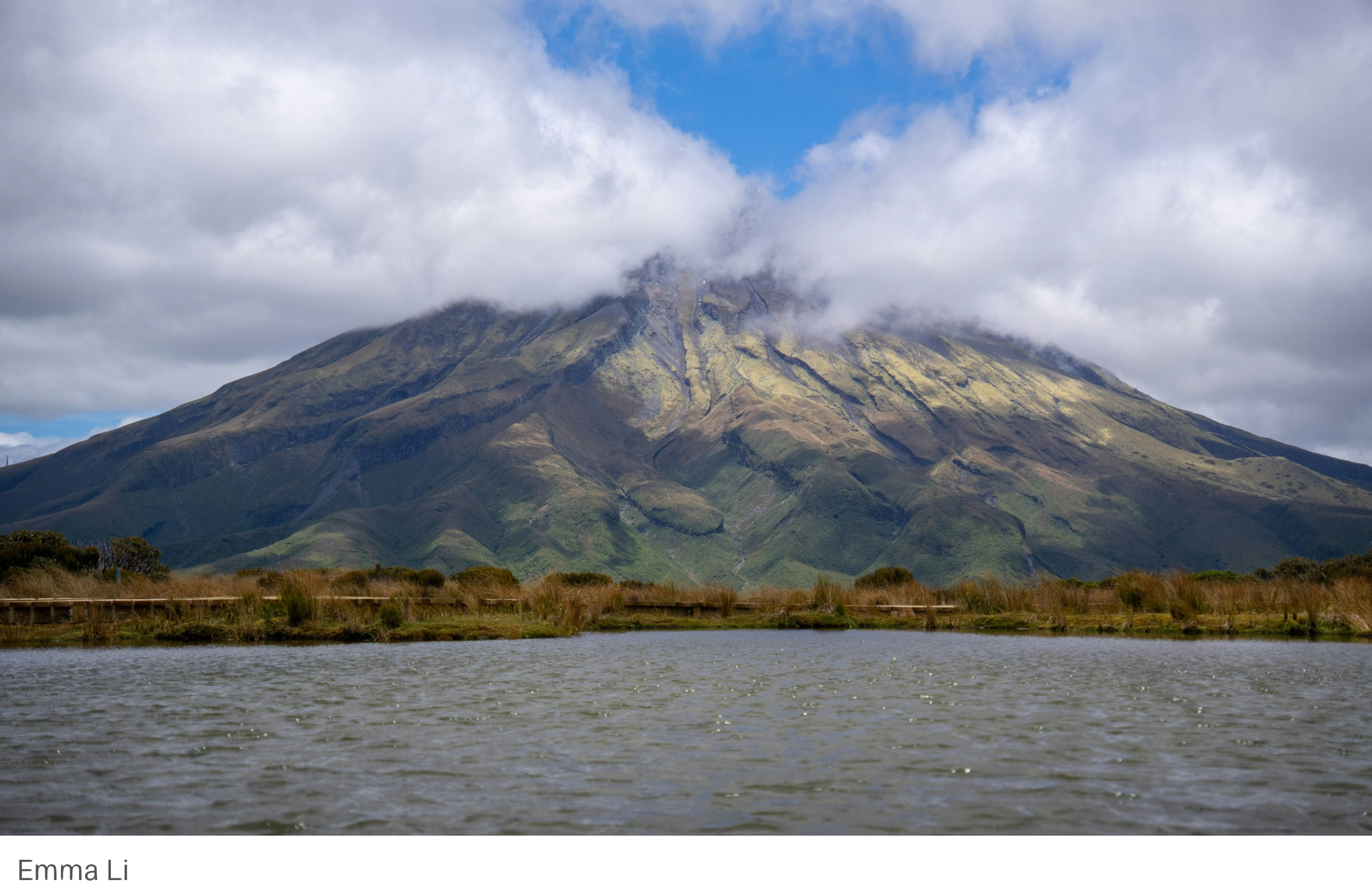
On January 30, 2025, hundreds of members of the Taranaki iwi, the region’s Māori tribes, traveled to Wellington, New Zealand’s capital. They went to witness Parliament formally recognize a mountain, Taranaki Maunga, and its surrounding peaks as a legal person. Nothing about the mountain itself changed that day, but what the law required of the people who live near it, govern it, and use it did.
The law names Taranaki Maunga, its companion peaks, and the surrounding land as one legal person: Te Kāhui Tupua. The person owns itself, and a representative body called Te Tōpuni Kōkōrangi acts on its behalf. Iwi chooses four of its members, and New Zealand’s conservation minister appoints the other four. The Department of Conservation calls this body the mountain’s human “face and voice”. Its job is to protect the mountain’s health and wellbeing.
The recognition of Te Kāhui Tupua’s personhood reveals a reorientation from treating the natural world as something humans control to recognizing the living world to which we have responsibilities.

“Humans become accountable to the natural world” is the third of Horizon 2045’s Seven Shifts. It asks us to give up the assumption that humans have dominion over all other life. It widens “us” to include the nonhuman world. Under this shift, we protect forests, rivers, and animals for their own flourishing, as well as for what they give us.
In this future, we reorganize our relationships and our institutions. Courts prosecute ecocide, the willful destruction of ecosystems, alongside genocide. Laws turn habitats from property into rights-bearing entities. Parts of this future already exist: Taranaki Maunga is New Zealand's third natural feature with legal personhood, after the Te Urewera forest in 2014 and the Whanganui River in 2017. A member of Denmark's governing coalition has committed to criminalizing ecocide under Danish law. Legal experts from 14 Latin American countries have drafted a Model Ecocide Law for parliaments across the region to adopt.
What the law can and cannot do
The Taranaki Maunga law does three concrete things. It creates an identity whose interests can be represented. It names who must represent them. It places the mountain’s wellbeing within government institutions, where agencies and courts must account for it.
The third shift imagines a future in which our growing understanding of nonhuman life changes the boundaries of legal protection. Ecosystems become rights-bearing entities and rivers receive legal personhood, which means stronger accountability for severe environmental destruction. The Seven Shifts explore these possibilities.
This is one law, in one place, shaped by one history. Other countries cannot copy it exactly for their own security challenges. It does show that institutions can change who, and what, they recognize as deserving protection. It also shows where that change starts: with listening to people whose knowledge has long rejected the idea that humans stand apart from the rest of the living world.
Why this is a security question
Security institutions decide what deserves protection. For most of the last century, the answer was the state. Then the human security movement moved the focus to people. The third shift pushes one step further. The living systems that sustain people also deserve protection. Once they count, the natural world stops being a concern that waits until security is handled. Protecting the conditions that sustain people and other living systems becomes part of what security is for.
Horizon 2045's Lex Mundi Nova initiative works on this equation in international law, beginning with nuclear weapons. More than 80 legal experts across 50 institutions are testing how advances in environmental law, human rights, and intergenerational justice could change what states may do with nuclear weapons, from uranium mining and waste to deployment and threat of use. In 1996, the International Court of Justice left that question open. Since then, laws like the one at Taranaki have widened who and what the law protects. Lex Mundi Nova is building the case to bring the question back to the Court. Nuclear weapons are the first test. The same legal strategy, which gives rivers rights, ecosystems standing, and future generations enforceable claims, is designed to constrain other high-risk technologies and entangled threats.
The story of Taranaki Maunga is about changing how humans act toward the mountain in a system that prioritizes humans over all other life. Today, eight people sit on Te Tōpuni Kōkōrangi with a job no security council has ever held: speaking for a mountain. The rest of us still must decide who speaks for the living systems our own security depends on.
This is the third in a seven-part series examining how each of The Seven Shifts, originally developed in 2021, continues to inform and intersect with Horizon 2045’s work today.
Author: Ava Lee-Green, Horizon 2045 Intern
