
The Seven Shifts: Untethering From the Past to Protect the Future
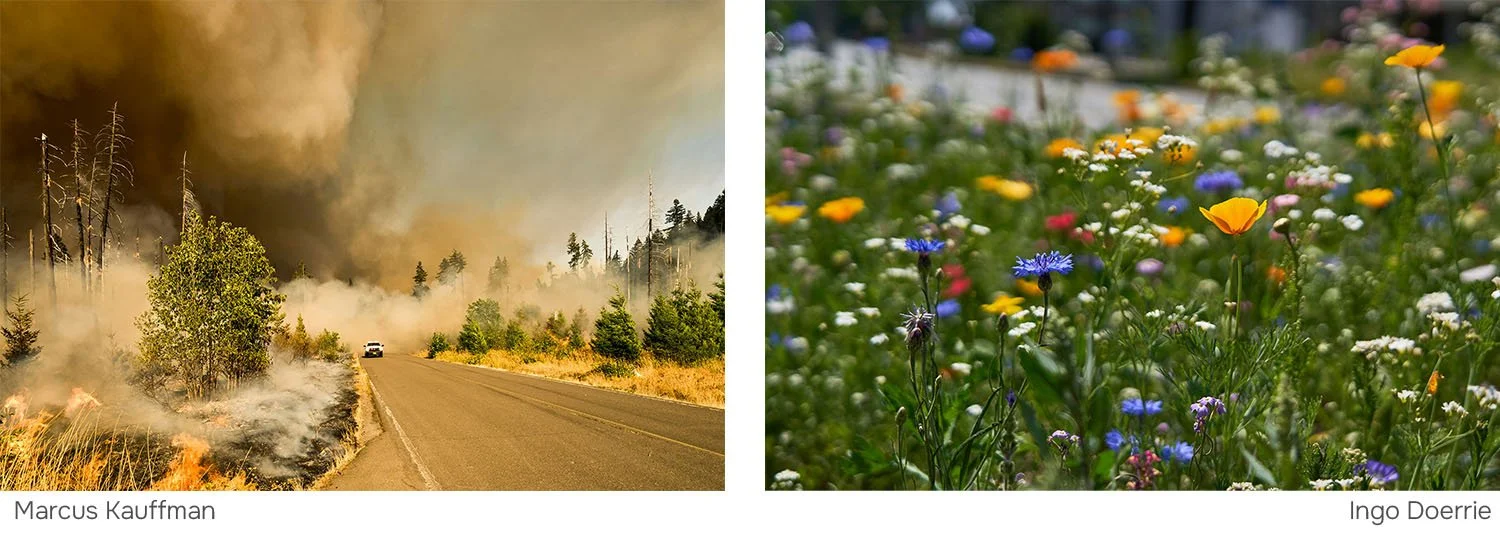
Across the United States, wildfire season has begun to redefine summer. What was once a season of long days spent outside in the sun, open windows in the evening, and family vacations is now increasingly marked by evacuation orders, hazy sunbeams, and the dread of waiting to learn whether a home, a street, or an entire neighborhood will still be there in the morning.
Every year during fire season, families are forced to evacuate their homes with little warning. Some return to find their lives reduced to ash and debris; others spend days or weeks in school gyms, hotel rooms, or temporary shelters, trying to imagine what rebuilding will look like, or whether rebuilding the life they had is even possible. For many, summer, once associated with rest, now carries memories of sirens, smoke, and displacement.
As we enter the final days of summer 2026, we are reminded of the first of Horizon 2045’s Seven Shifts. Like our relationship to this season, this is a story about grief, adaptation, and the increasingly urgent work of deciding what can still be protected and what must be released.
The Seven Shifts
For decades, many of the world’s security systems were built on the idea that preserving enough of the present would protect the future. Yet that assumption is increasingly breaking down. Climate change is reshaping where people live, how states govern, how resources are shared, and how instability spreads. At the same time, geopolitical tensions, democratic backsliding, technological disruption, and nuclear risk continue to interact in ways that make previous security logic feel increasingly inadequate.
Horizon 2045 developed The Seven Shifts as part of its early futures work to explore the broader forces reshaping global security. Instead of treating security risks as isolated issues, the document examines the contextual changes already underway—from climate disruption and governance challenges to transparency and knowledge—that are changing how we understand security, responsibility, and the future.
The Seven Shifts were conceived as stories of profound change. They are ways of imagining how the future may unfold, where the old operating model is breaking down, and what kinds of transitions might become possible if we are willing to examine today’s institutions critically. Taken together, they highlight the challenges the old security order is already facing and suggest where new possibilities may emerge.

The first shift—we untether from the past and orient toward the future—asks readers to confront the reality that some losses are no longer preventable. As climate change intensifies, familiar responses are becoming less effective. Some places can be defended for a time, but not forever. Some landscapes can be repaired, but not fully restored. Some communities will discover that the cost of holding on is greater than the cost of letting go.
In that reckoning, the work must no longer be to preserve every remnant of the world we inherited.
This shift is emotional as much as it is strategic. It is about mourning what is lost—species, shorelines, forests, and communities—while recognizing that the past cannot be dragged forward indefinitely. Many writers and practitioners working on climate grief and adaptation describe this as the need to remain aware of decline and disruption without turning away, even as the world prepares for what will need to be rebuilt. Wildfire survivors are intimately familiar with this work. Rebuilding after a fire is rarely just about restoration; it often means deciding what can be remade, what must be released, and what resilience looks like when “home” is no longer a concrete structure.
The organization’s central insight is that the opportunity for reimagination often lies on the other side of traumatic change. In wildfire-affected communities, security now means the capacity to live with constant change. Letting go of old expectations is a real loss: the assumption that a home or a landscape would simply stay put. But the adaptation that follows brings its own advantages: fire-resistant materials that hold up longer, a deeper working relationship with the land, and neighborhoods redesigned so that people are more connected to each other, better prepared, and less isolated than before the fire came.
The first shift matters because it names the kind of mental and cultural realignment required to confront that reality—one that moves beyond preservation alone and toward the challenging work of protecting what can still be protected, letting go of what cannot, and building as if the future depends on the world’s willingness to adapt.
This is the first in a seven-part series to be published over the coming months, examining how each of The Seven Shifts, originally developed in 2021, continues to inform and intersect with our work today.
Author: Ava Lee-Green, Horizon 2045 Intern