
The Seven Shifts: Safeguarding the Wellbeing of Future Generations
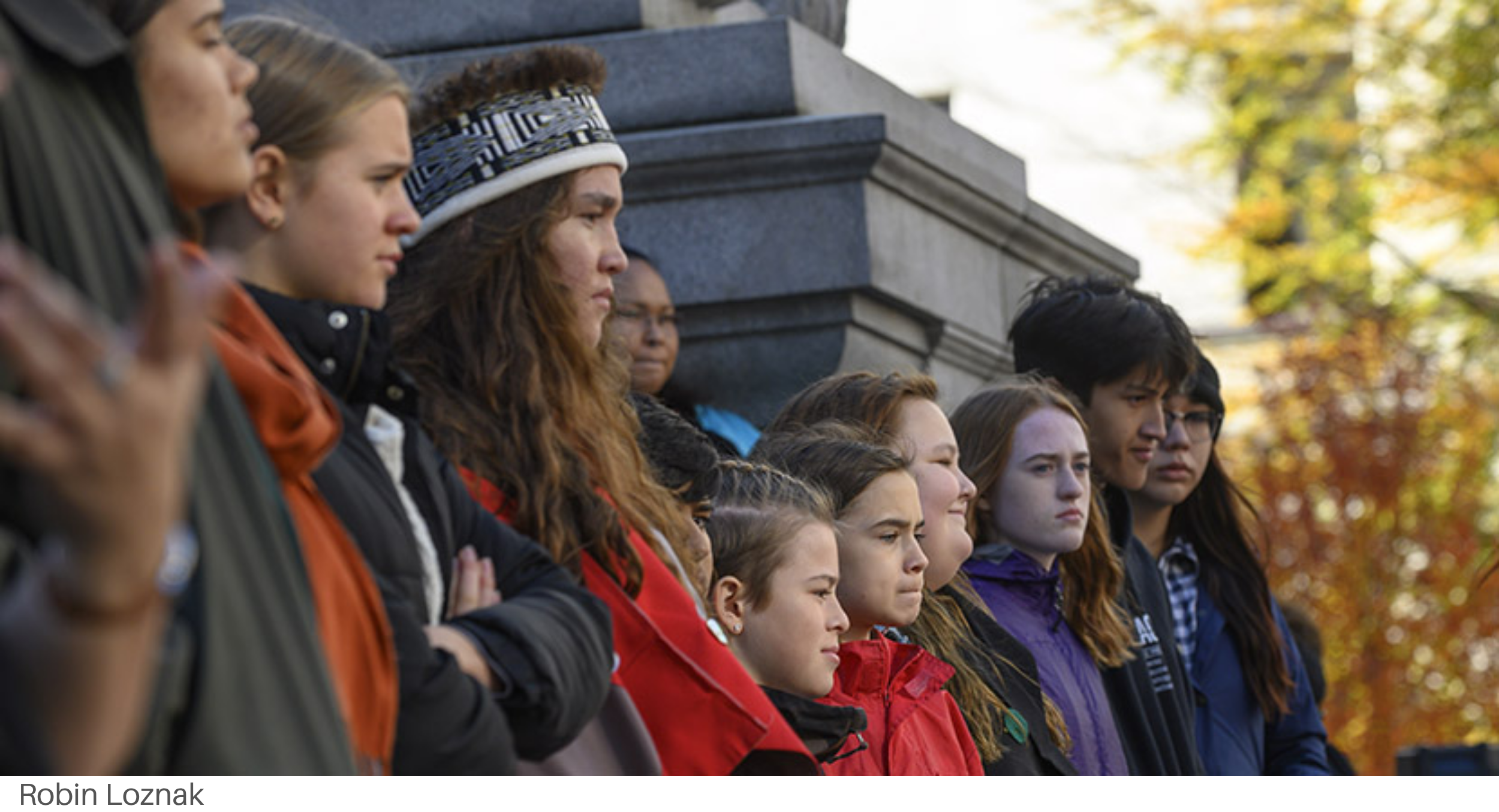
On October 26, 2026, Canada’s first youth-led climate lawsuit will go to trial in Vancouver, British Columbia. In La Rose v. His Majesty the King, fifteen young plaintiffs are challenging the Canadian federal government over its contribution to climate change.
The plaintiffs argue that the government’s support for fossil fuel development and inadequate greenhouse-gas targets violate their rights to life, liberty, and security under Section 7 of the Canadian Charter of Rights and Freedoms. They also argue that climate change places a disproportionate burden on young people and future generations, violating Section 15’s guarantee of equal protection under the law.
These fifteen young people preparing for trial against the Canadian government are not seeking monetary compensation. They are asking for science-based climate recovery plans that acknowledge the worsening consequences the younger generations will face as a result of today’s decisions.
Their case is just one example of a larger reorientation: from a world organized around the present to one that takes responsibility for the future.
Safeguarding the Promise
“We safeguard the wellbeing—and the promise—of future generations” is the second of Horizon 2045’s Seven Shifts. It calls for a major reorientation of global priorities. Rather than sustaining systems that leave the world in worse condition than we found it, the shift asks what becomes possible when future generations are placed at the center of decision-making.

This requires confronting an imbalance. Our institutions are organized around short horizons: the next election, disaster, or political fight. They each demand immediate attention, and together, crowd out threats whose gravest effects will only be felt generations from now.
Those who will inherit today's decisions have no seat at the table. They cannot hold governments accountable for global warming, biodiversity loss, unregulated technology, or nuclear escalation. Thus, they depend on us to recognize that responsibility before the damage is irreversible. At the heart of the second shift, then, is an intergenerational challenge. While certain choices may seem defensible today, they steadily narrow the range of possibilities available to those who follow.
Signs of Reorientation
There are already signs that future-facing governance is becoming more visible. The UN’s Pact for the Future and its Declaration on Future Generations formally recognize the need to consider future interests in present decisions. Their significance, however, will depend on whether those commitments reshape institutions, funding priorities, laws, and international cooperation.
In 2025, the International Court of Justice (ICJ) also delivered a landmark advisory opinion on states’ obligations concerning climate change. The opinion reinforced the principle that climate action is connected to states’ duties under international law. Together, these developments indicate a growing recognition that present-day decisions can create responsibilities to the people who will face their consequences later.
The second shift imagines these commitments expanding in reach and influence. Future-oriented planning becomes standard practice, enabling governments to create sustainable ways to assess irreversible harms. Across generations, people will begin to understand themselves as both inheritors of the past and ancestors of the future.
Security Across Generations
For Horizon 2045, the second shift is less a proposal for the future than a practice for the present. It clarifies that security cannot be understood only as the protection of people, territory, or national interests within the span of a lifetime. Instead, security must mean creating and safeguarding the conditions in which people and living systems can survive over time.
That understanding has sharpened Horizon 2045’s mission and informed where we direct our resources. Today’s entangled issues like climate disruption, democratic backsliding, nuclear risk, economic insecurity, and public health crises interact, reinforce one another, and can transfer harm across borders and generations. A system that responds to each threat in isolation may manage individual symptoms while continuing to reproduce the conditions of insecurity.
The second shift asks us to move beyond the assumption that responsibility ends with the world we can directly affect during our own lifetimes. It calls for a longer and wider horizon of responsibility: to the children already living with the consequences of past decisions; to people whose futures will be shaped by choices made far from where they live; and to the ecosystems on which all futures depend.
Horizon 2045 is testing this shift through work that will make long-term decision-making more practical. Women Transforming Global Security (WTGS) convenes senior women leaders and former heads of state to reexamine what security is for and who gets to shape it. The initiative develops tools that help reveal how choices in one domain can compound risk and create opportunity for progress in another.
Lex Mundi Nova similarly draws on intergenerational equity, human rights, climate, and public health law to address accountability gaps that arise when institutions govern interconnected threats separately. This work recognizes that weapons-related harms, environmental harms, and harms to future generations cannot always be meaningfully addressed through the legal and policy systems from the past.
Becoming Good Ancestors
The future is often framed as something distant: a destination toward which we are moving. In reality, it is being shaped now—in the lives of children, in communities navigating disasters, in the health of forests, and in the systems we build, or leave unchanged, to manage risks that will outlast us.
Safeguarding the wellbeing of those who come after us means designing laws, institutions, security frameworks, and funding strategies around the long-term flourishing of people, communities, and ecosystems. It means looking beyond the next crisis, political cycle, or narrow conception of national interest, to recognize how decisions in one domain can constrain or expand possibility elsewhere, now and in the future.
This is the second shift’s invitation. It calls for us to understand ourselves both as beneficiaries of the world we inherited and as its stewards. Becoming good ancestors means security for a truly livable world.
This is the second in a seven-part series to be published over the coming months, examining how each of The Seven Shifts, originally developed in 2021, continues to inform and intersect with our work today.
Author: Ava Lee-Green, Horizon 2045 Intern
